
There is a certain stage in a growing business where having someone enter transactions is no longer enough. The books are getting done, but nobody is analyzing them. Nobody is catching the trends, flagging the variances, or making sure the financial statements actually reflect what is happening. That is not a bookkeeping problem. That is a controller problem.
What Is a Controller?
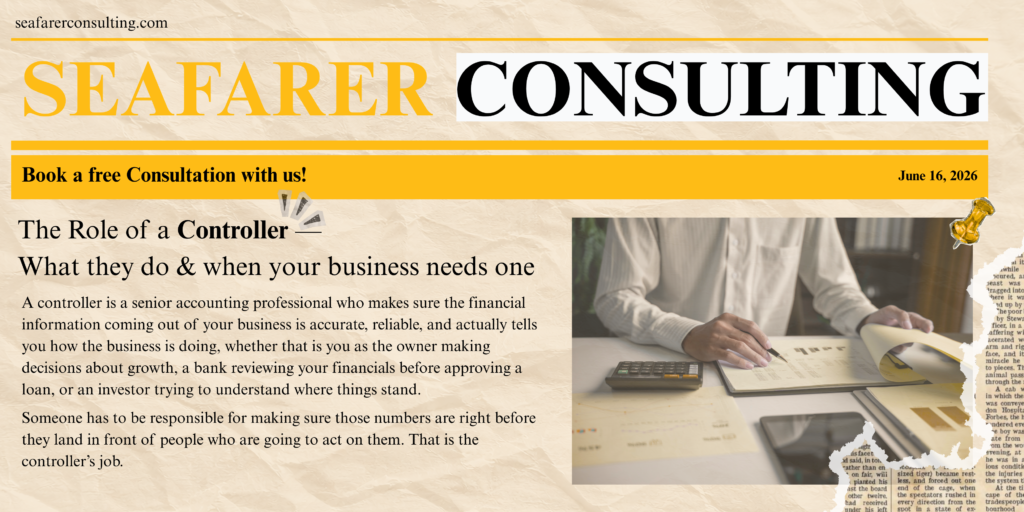
A controller is a senior accounting professional who makes sure the financial information coming out of your business is accurate, reliable, and actually tells you how the business is doing, whether that is you as the owner making decisions about growth, a bank reviewing your financials before approving a loan, or an investor trying to understand where things stand.
Someone has to be responsible for making sure those numbers are right before they land in front of people who are going to act on them. That is the controller’s job.
They are not doing the day-to-day transaction work. Your bookkeeper and junior accountants handle that. The controller is the person making sure all of that work adds up to something accurate and reliable.
How the Accounting Team Fits Together
Picture a pyramid. At the bottom, bookkeepers and junior accountants handle the transactions — entering invoices, recording payments, and categorizing expenses. Above them, an accounting manager reviews that work and makes sure it is complete. At the top sits the controller, reviewing the full financial picture at month-end and making sure the numbers actually make sense.
For larger payments, the controller is often the one who reviews and approves before anything goes out. Month-end is where a controller really earns their place. Rather than just checking that transactions were entered, they go through the financial statements looking for anything that seems off – an account balance that jumped compared to last month, an expense that looks higher than usual, a revenue figure that does not match what was expected.
It is not about auditing every single line. It is about knowing what normal looks like for that business and catching anything that does not fit before it becomes a real problem.
Controller vs. Bookkeeper — What Is the Real Difference?
A bookkeeper is focused on keeping up with transactions as they happen — entering the data, making sure invoices are recorded, and reconciling accounts. It is detailed, necessary work, but it is mostly transactional.
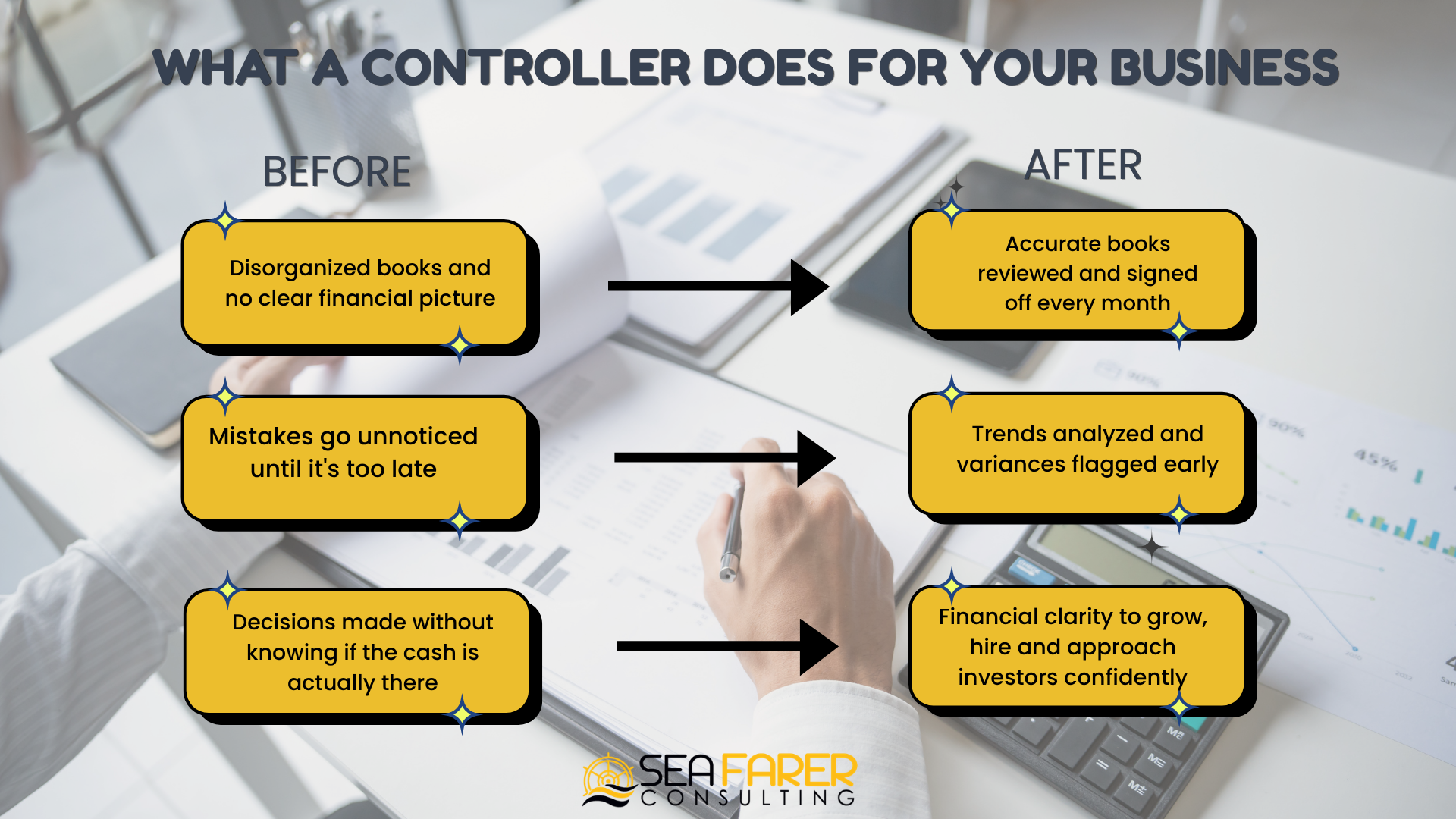
A controller is focused on what those transactions mean once they are all in. They are analyzing trends, reviewing whether accounts are properly categorized, checking that accruals and prepaids are handled correctly, and making sure the financial statements paint an accurate picture of the business.
It requires a different level of experience and a different mindset — less about recording what happened, more about understanding what it means.
What a Controller Actually Does Each Month
Beyond the high-level oversight, controllers are involved in specific and consequential work every month:
- Reviewing financial statements line by line for unusual activity
- Verifying that recurring items like prepaid expenses and accruals are properly accounted for
- Troubleshooting when something does not reconcile – a bank statement that is off, a journal entry posted to the wrong account, a vendor set up incorrectly
- Approving significant outgoing payments before they are processed
- Making sure everything balances before financials go to the owner, a lender, or an investor
That last point matters more than most business owners realize. The financial statements a controller signs off on are the ones that get used to make real decisions.
A Real Example: What Controller-Level Oversight Changed for a Seafarer Client
When Seafarer took on a precision medicine company as a client, the books needed significant work. The previous accounting team had left journal entries incorrect, reconciliations incomplete, and financial statements that gave the owner no real visibility into how the business was performing.
Seafarer’s controller reviewed everything from the ground up, identified what needed to be corrected going back into 2024, and worked with the accounting manager to get it done.
One of the more impactful changes involved payroll. Instead of recording all wages in a single expense line, the controller created separate accounts for administrative payroll, warehouse payroll, and purchasing payroll — and moved the appropriate portions into cost of goods sold. That one change gave the owner a much clearer picture of where money was actually being spent and what it was producing.
By the time the cleanup was complete, the owner had financial statements he could stand behind — and was able to approach a bank for a line of credit with confidence. That is what controller- level oversight makes possible.
Does Every Small Business Need a Controller?
Not at every stage – but every business reaches a point where having someone who can interpret the financial statements becomes essential.
Every owner wants to know the same things: is the business actually making money, can it afford to grow, and is adding a new service or product a smart move right now? Those are not questions a bookkeeper can answer. They require someone who can sit down with the financials, understand what they are showing, and translate that into something the owner can act on.
Without that, decisions get made on instinct rather than data — and that is where things tend to go wrong when the stakes are high.
According to a U.S. Bank study, 82% of small business failures are caused by cash flow problems, not a lack of profitability. A controller who is actively reviewing your financials and flagging issues early is one of the most direct ways to prevent that outcome.
Signs It Might Be Time to Bring in a Controller
Use this as a self-diagnostic. If any of these apply, it is worth having a conversation:
- Your financials are being produced, but nobody is analyzing them. Numbers come in each month, but no one is reviewing trends, flagging variances, or connecting the data to the decisions being made.
- Volume has outgrown your current team. Things that used to take a day now take a week. Some things are not getting done at all.
- You want to grow, but cannot confirm that the business can support it. You are thinking about hiring, expanding, or adding a service — but you genuinely do not know if the numbers back it up.
- You need to approach a lender or investor. Banks and investors want to see accurate, well-organized financials. If yours are not in that shape, getting a controller involved before that conversation is the right move.
- You have had a financial surprise you should have seen coming. A cash shortfall, an unexpected tax liability, a reconciliation that was off for months — these are signs the oversight layer is missing.
Fractional Controller vs. Full Time — What Makes Sense for a Small Business?
Hiring a full-time controller is a real financial commitment for most growing businesses. According to the U.S. Bureau of Labor Statistics, the median annual wage for financial managers, a category that includes controllers, was $161,700 as of May 2024.
For most small businesses, the actual need is 10 to 20 hours a month, not 40. Paying a full-time salary for part-time work is a cost that does not make sense until the business reaches a certain scale.
A fractional controller offers the same expertise on a part-time basis. According to Jumpstart Partners, fractional controller services typically cost between $2,000 and $7,500 per month for small to mid-sized businesses — making it 70 to 85% more cost-effective than a full-time hire for companies under $5 million in revenue.
For businesses that are growing but not yet at the scale where a full-time financial hire is necessary, a fractional controller gives you accurate financials, experienced oversight, and a clear picture of where the business stands – without adding a senior salary to your payroll. Many businesses start with a fractional team and transition to a full-time hire as their needs grow. It is a model that scales with you.
How Seafarer Consulting Helps
At Seafarer Consulting, controller services are built into how we support clients at the right level. Our controllers review financial statements, oversee month-end close, identify issues early, and work alongside the accounting team to make sure the numbers you receive each month actually reflect what is happening in your business.
Whether your books need a cleanup before we can establish a clean baseline, or you are looking for ongoing oversight as you grow, we work with you at whatever stage you are at.
If you are making financial decisions without confidence in the numbers behind them, that is exactly the kind of situation we are here for. Book a free consultation at seafarerconsulting.com and let’s take a look together.