
When should a small business hire a bookkeeper? The answer isn’t really about hitting a specific revenue number. It’s more about whether your financial records are still accurate, current, and manageable.
When you keep pushing your reconciliations back, bookkeeping starts taking up time that should be spent running your business. Plus, if you reach a point where you can’t explain what happened financially last month, then you need to bring in help.
The goal isn’t just to stop handling the books yourself. It’s to reach a point where your books actually give you valuable information you can use to grow.
There Is No Magic Revenue Number
A common misconception is that a business should wait until it reaches a certain amount of revenue before hiring a bookkeeper.
A simple business with few transactions might be able to handle its bookkeeping internally for a while. On the other hand, another business with lower revenue but multiple bank accounts, employees, inventory, payment platforms, or a high volume of transactions may need professional support much earlier.
IRS recordkeeping guidance focuses on maintaining records that clearly show income and expenses rather than on a specific revenue milestone for hiring a bookkeeper. Businesses may use different recordkeeping systems as long as the records clearly show their income and expenses.
So the better question is not, “How much revenue are we making?” The right question is:
Can our current bookkeeping process still keep up with the business?
If you’re still deciding whether your business needs bookkeeping or higher-level accounting support, see our guide on Bookkeeping vs. Accounting: What’s the Difference for a Small Business?
When Should a Small Business Hire a Bookkeeper? 7 Signs to Watch
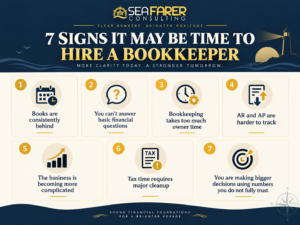
1. Your Books Are Consistently Behind
When your transactions sit uncategorized for weeks, your bank reconciliations fall several months behind, or your financial statements only get cleaned up around tax time, the process is clearly not keeping up with your business.
The IRS notes that recording transactions as they happen is a good recordkeeping practice and generally recommends recording transactions on a daily basis.
That doesn’t mean every small business needs a bookkeeper entering transactions every single day. It simply means that when your records are consistently falling behind, it becomes much harder to trust your financial reports when you actually need them.
2. You Cannot Easily Answer Basic Financial Questions
If it takes you hours of cleaning up spreadsheets or reconciling accounts before you can answer basic questions like:
- What did we make last month?
- What do customers currently owe us?
- What bills are coming due?
- Which expenses increased?
- Are our bank and credit card balances reconciled?
- Are we actually becoming more profitable?
then your bookkeeping process is no longer giving you reliable financial visibility.
A good bookkeeping system should help you answer these questions without rebuilding the numbers first. Up-to-date books make your profit and loss statement and balance sheet useful management tools, not just reports you look at during tax season.
3. Bookkeeping Is Taking Too Much of the Owner’s Time
In the early stages of running a business, doing your own bookkeeping makes total sense. But as you grow, there comes a point where the owner’s time becomes far too valuable to spend on basic data entry.
If bookkeeping has started eating into your evenings or weekends, ask yourself what else you could do with those hours. What is more valuable to your business right now?
- Serving your customers
- Generating new sales
- Hiring key team members
- Improving operations
- Reviewing high-level performance rather than entering transactions
The decision to delegate doesn’t come down to a fixed number of hours spent. Instead, the real question is:
Is bookkeeping still a reasonable owner responsibility, or has it become an operational role of its own?
Recognizing that distinction makes all the difference.
4. Accounts Receivable and Accounts Payable Are Becoming Harder to Track
Bookkeeping isn’t just about recording transactions you’ve already done or tracking money you spent or earned in the past. It is also about managing core financial tasks like:
- Accounts Receivable: Knowing who owes you money, how much they owe, and how late their payment is.
- Accounts Payable: Knowing what bills your business owes and when you need to pay them.
The Small Business Administration (SBA) lists accounts receivable, accounts payable, available cash, bank reconciliation, and payroll among important financial areas businesses need to manage.
If customer invoices are constantly overdue, vendor bills are getting lost in your email inbox, or you aren’t sure how much cash you actually have today, it may be time to bring in professional bookkeeping help.
5. Your Business Has Become More Complicated
Your bookkeeping workload doesn’t grow just because your sales are going up. It also grows when your business structure gets more complicated.
Complexity increases when you:
- Hire employees or run payroll
- Add new bank accounts or credit cards
- Carry physical inventory
- Open a second location, start a new company, or launch a new product line
- Use sales and payment platforms like Shopify, Square, or Stripe
- Start collecting sales tax or paying off business loans
Each new tool or account adds more transactions, making it harder to categorize and reconcile everything accurately.
This is why a simple business making $500,000 can actually be easier to keep books for than a $200,000 business with inventory, payroll, and three different online sales channels.
A Quick Bookkeeper Readiness Test
Instead of worrying about your total revenue, ask yourself these five simple Yes/No questions:
| Question | Yes | No |
| 1. Are all your bank and credit card accounts reconciled every single month? | ☐ | ☐ |
| 2. Can you pull up last month’s Profit & Loss statement without cleaning up your books first? | ☐ | ☐ |
| 3. Do you know exactly who owes you money and what bills you owe right now? | ☐ | ☐ |
| 4. Is one specific person clearly responsible for finishing your books every month? | ☐ | ☐ |
| 5. Can your CPA file your taxes without spending hours fixing months of old transactions? | ☐ | ☐ |
The Bottom Line: As a practical rule of thumb, if you answered “No” to two or more questions, it may be time to take a closer look at whether your current bookkeeping process is keeping up.
That doesn’t automatically mean you need a full-time employee. It may simply mean you need professional bookkeeping support to create a more reliable process.
When should a small business hire a bookkeeper? In practical terms, it is when the current process is no longer keeping the books accurate, current, and useful.
6. Tax Time Requires a Major Cleanup Every Year
Your CPA or tax preparer should not have to rebuild your books from scratch before they can file your taxes.
The IRS requires business records to support the income, expenses, and credits reported on a tax return.
If every tax season turns into chaos full of:
- Missing receipts
- Uncategorized or misplaced expenses
- Unreconciled bank and credit card accounts
- Confusion over whether purchases were personal or business-related
then you are doing additional catch-up bookkeeping work after the fact.
Having a consistent monthly process makes year-end significantly easier, cleaner, and less stressful.
7. You Are Making Bigger Decisions Using Numbers You Do Not Fully Trust
Big decisions, like hiring staff, buying new equipment, raising prices, taking out loans, or opening a second location, require accurate financial numbers.
When you base major moves on financial records that are disorganized or incomplete, making those decisions can feel like a wild guess.
It is important to remember what a bookkeeper actually does. A bookkeeper’s job isn’t to make big strategic decisions for you. What they do is provide accurate, organized financial information so you can make those choices with greater confidence instead of guessing.
Later, as your company grows, you may eventually need higher-level financial guidance from an accountant, controller, or fractional CFO. But all of those roles rely on solid, reliable bookkeeping.
Bookkeeping is the foundation that allows those higher-level financial functions to work properly.
When Should a Small Business Hire a Bookkeeper, and What Should You Hand Off First?
You don’t have to outsource everything at once. You can take this step-by-step by starting with the core tasks that build a solid financial foundation:
- Bank and credit card reconciliations
- Transaction categorization
- Accounts payable (AP) and accounts receivable (AR) tracking
- Supporting document and receipt organization
- Monthly financial statements
- Cleanup or catch-up work if prior months are falling behind
Once these core processes are running consistently and accurately, you can then decide whether additional tasks, like running payroll, paying bills, managing collections, or custom reporting, should also move to your bookkeeping team.
Should You Hire In-House or Outsource?
Once you decide you need help, the next question is what type of help fits your business best:
- In-House Bookkeeper: Makes sense when your financial tasks require daily, ongoing attention and you have enough workload to justify a dedicated employee.
- Outsourced Bookkeeping Firm: Makes more sense when you need consistent monthly support and reliable systems but don’t need a full-time person on staff.
- Solo Freelancer: Another flexible option, although their level of backup coverage, availability, and broader expertise can differ from working with an established firm.
Need help deciding which route to take? We break down this exact decision in our guide to Outsourced vs. In-House Bookkeeping.
How Much Should You Expect to Spend?
When should a small business hire a bookkeeper? Cost matters, but the decision usually depends more on workload, complexity, and how reliable your current financial records are.The cost depends on your transaction volume, business complexity, scope of work, and whether you decide to hire a dedicated employee, a freelancer, or a professional bookkeeping firm.
Rather than turning this section into a full pricing breakdown, you can find the details and numbers in our guide: How Much Does Bookkeeping Cost for a Small Business?
The most important question to ask isn’t just “What does it cost?” but rather:
Is the cost of professional bookkeeping justified by the time, reliability, and visibility it gives back to your business?
What Should Good Bookkeeping Look Like After You Hire?
The process doesn’t stop once you make a hire. Hiring someone is not the final goal. Getting a better, clearer financial process is the main goal.
Once you have a reliable bookkeeping system in place, you should expect to see:
- Clean Accounts: Bank and credit card accounts are reconciled consistently each month.
- Fewer Missing Items: Uncategorized expenses, unexplained transfers, and missing receipts are identified and resolved regularly.
- Clear AR/AP Position: You can quickly see who owes you money and which bills are coming due.
- Predictable Deadlines: You receive monthly financial reports on an agreed schedule.
- Easier Tax Prep: Year-end cleanup is lighter because the books have been maintained throughout the year.
- Clear Accountability: You know who is responsible for each financial task.
The Ultimate Goal: You spend less time going through old transactions and trying to reconstruct what happened, allowing you to focus on using accurate numbers to run and grow your business.
When Should a Small Business Hire a Bookkeeper Instead of an Accountant?
A bookkeeper is usually the right starting point when you need accurate, up-to-date records, reconciliations, and consistent monthly bookkeeping. An accountant is generally brought in for higher-level accounting, tax, or financial analysis needs.
For a full breakdown of the roles, read our guide on Bookkeeping vs. Accounting: What’s the Difference for a Small Business?
Frequently Asked Questions
When should a small business hire a bookkeeper?
A small business should consider hiring a bookkeeper when its financial records are regularly falling behind, the owner is spending too much time maintaining them, or the business can no longer rely on its current bookkeeping process for accurate monthly information.
Do I need a bookkeeper if my business is small?
Not necessarily. A very simple business with low transaction volume may be able to manage bookkeeping internally. Complexity, transaction volume, available time, and the reliability of the records are generally more useful indicators than business size alone.
Is there a certain revenue level when I should hire a bookkeeper?
There is no universal revenue threshold. A lower-revenue business with payroll, inventory, multiple accounts, or several sales channels may need bookkeeping support earlier than a larger but simpler business.
Should I hire a bookkeeper before tax season?
Ideally, bookkeeping should be maintained throughout the year rather than reconstructed at tax time. Consistent records make it easier for your tax professional to work from complete financial information.
Can I hire a bookkeeper just to clean up old books?
Yes. Catch-up or cleanup bookkeeping can bring prior months or years current before moving into ongoing monthly bookkeeping.
Should I hire an employee or outsource bookkeeping?
That depends on how much daily support you require, the amount of work available, your budget, and whether you need access to a broader team. Businesses that do not need full-time coverage often consider outsourced support.
Talk to Seafarer Consulting
Seafarer Consulting provides bookkeeping support for businesses that need cleaner records, consistent monthly reconciliations, catch-up work, and a reliable month-end process.
If your books are falling behind or you are unsure whether it is time to bring in support, we can review your current setup and help determine what level of bookkeeping makes sense.