If you’ve ever checked your bank account, felt like things were fine, and then got hit with a bunch of unpaid bills out of nowhere, you’ve already experienced the difference between cash and accrual accounting without knowing it. Most small business owners just pick a method when they’re starting out and never really think about it again.
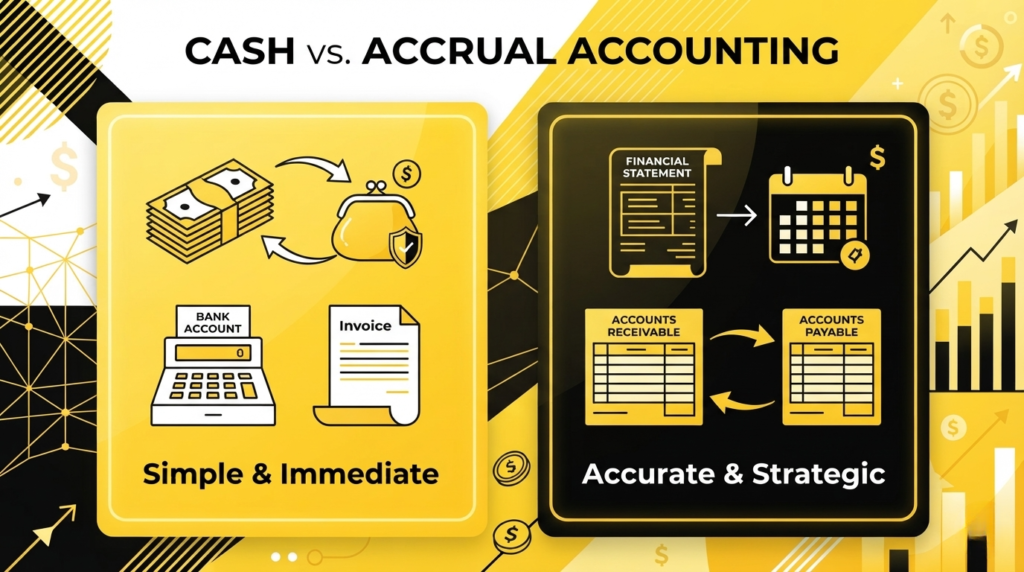
However, what works when your business is small doesn’t always work as things start to grow. So here’s a breakdown of both methods and how to know when it might be time to switch. In simple terms, cash accounting records income and expenses when money actually moves in or out of your account, while accrual accounting records them when they are earned or incurred, regardless of when cash changes hands.
The method you use affects your financial statements, your taxes, and, in some cases, you may not even get to choose.
What Is Cash Accounting?
Cash accounting is the method where you record income when money actually comes in and expenses when money actually goes out. If a client pays you in June, that’s June income. If you receive a utility bill in June but pay it in July, that becomes a July expense. It’s simple, straightforward, and works perfectly for many small businesses just getting started. For companies that need reliable accounting services for companies, cash accounting offers a clear view of the bank balance, how much money is coming in, and how much is going out.
What cash accounting does well:
- Simple to maintain and easy to understand
- Lower bookkeeping complexity
- Gives a clear view of actual cash coming in and going out
- Works well for freelancers and small service businesses with low transaction volume
Where it starts to fall short:
- When you have unpaid invoices or vendor bills, your books don’t tell the full story
- Hard to do meaningful budgeting or forecasting
- Bank balance alone can become misleading as the business grows
- Lenders and investors generally prefer accrual-based financials
What Is Accrual Accounting?
Accrual accounting records income when it’s earned and expenses when they’re incurred, regardless of when cash actually moves. So if you make a sale in June but the customer has 30 days to pay, that’s still June revenue. And if you receive a utility bill in June but pay it in July, it shows up as a June expense. The result is a much more accurate picture of how your business is actually performing month to month, with June staying in June and July staying in July. You can look back at your financials to see which months were profitable and which were slow, and plan accordingly.
What accrual accounting does well:
- More accurate financial statements as income and expenses match the period they actually belong to
- Supports budgeting and forecasting based on real trends
- Stronger reporting for lenders and investors
- Better insight for strategic decisions at the controller level
- Makes it possible to track accounts receivable, accounts payable, inventory, and other balance sheet items properly
Where it’s more complex:
- More moving parts and higher bookkeeping complexity
- Requires understanding of balance sheet accounts, like accounts receivable and accounts payable
- Takes more time to set up and maintain properly
Cash vs Accrual: How They Compare
| Category | Cash Accounting | Accrual Accounting |
| Income recorded | When cash is received | When the sale is made/earned |
| Expenses recorded | When cash goes out | When an expense is incurred |
| Complexity | Simple | More complex |
| Best for | Small businesses and freelancers | Growing businesses, inventory, AR/AP, investors |
| Forecasting/budgeting | Limited | Strong |
| Lender/investor reporting | Less preferred | Preferred |
| Accounts receivable/payable | Not tracked | Tracked on the balance sheet |
| Quickbooks Online | Supported | Supported |
Which Industries Tend to Use Each Method?
Cash accounting works well for freelancers, consultants, and very small service businesses where transactions are straightforward and volume is low. For example, if you run a small business with 25 transactions a month, cash accounting is probably all you need.
Accrual accounting is generally the better fit for construction, manufacturing, retail, e-commerce, healthcare, property management, and any company looking to bring in investors or secure a line of credit. That said, carrying inventory does not automatically mean you have to use accrual accounting. Since the 2017 Tax Cuts and Jobs Act, businesses with average annual gross receipts under the IRS threshold ($32 million for 2026) can use cash accounting even if they carry inventory. Inventory is a strong reason why accrual accounting gives you more useful financial information, but it is no longer the primary driver of the switch for most small businesses.
The Biggest Misconception: Profit Doesn’t Equal Cash
One of the most common things business owners get wrong is assuming that if the business is profitable, there should be cash in the bank. That’s not always true. A business can be profitable on paper and still have very little cash if customers haven’t paid yet. Under accrual accounting, that $400,000 in accounts receivable shows up as an asset on your balance sheet, but it’s not in your bank account. Cash accounting wouldn’t reflect that sale at all until the money actually arrives. That’s why looking at your financial statements through an accrual lens gives you a much fuller picture of where your business actually stands.
How Does This Affect Taxes?
The accounting method you choose affects when income and expenses are recognized for tax purposes, which means it can impact your taxable income in a given year. It also affects how useful your financial reports are when filing.
One thing worth knowing: QuickBooks Online can run reports using either method, so you can toggle between cash and accrual views. But just changing the reporting setting doesn’t convert your books; a proper transition from cash to accrual accounting requires cleaning up the balance sheet, including accounts receivable, accounts payable, prepaids, inventory, fixed assets, and accrued expenses.
So, When Should You Switch?
There’s no one-size-fits-all answer, but here are some clear signs it might be time to move from cash to accrual accounting:
- You have customers who pay on net 30 or net 60 terms
- You have vendor bills that don’t get paid the same month they come in
- You’re trying to get a business loan or bring in investors
- You want to do real budgeting and forecasting based on monthly trends
- Your transaction volume is growing, and your bank balance alone isn’t telling the full story
On the flip side, if you’re a freelancer or a very small service business with straightforward transactions and low volume, cash accounting might still be perfectly fine for where you are right now.
Many business owners are surprised by this rule. You may not have a choice in the matter. Under IRC Section 448, certain businesses must use accrual accounting. The IRS requires C corporations, partnerships with a C corp partner, and tax shelters to switch. They switch when their average receipts over the prior three years exceed the thresholds for 2026 and 2025, with amounts indexed annually by the IRS. If you are an S corporation or sole proprietor, you may keep cash accounting at any revenue level. For a growing C corp, this is not a risk you want to learn about after the numbers rise. When in doubt about which rules apply, seek answers early to prevent problems down the line.
How can Seafarer Consulting help?
At Seafarer Consulting, we know there’s no one-size-fits-all approach to bookkeeping. Some businesses thrive with accrual accounting, while others benefit from staying on a cash basis. The best choice depends on where your business is today, where you want it to go, and the financial decisions you need to make with confidence.
What matters most is having accurate, up-to-date books. Clean financial records give you a reliable view of cash flow, profitability, and growth opportunities—regardless of the accounting method you use. Messy books, on the other hand, can make even the “right” method difficult to rely on.
Not sure whether cash or accrual accounting is right for your business—or considering a switch? Book your free bookkeeping strategy call with Seafarer Consulting today. We’ll review your current setup, discuss your goals, and give you clear, practical guidance on the best path forward.
Frequently Asked Questions
Does inventory require accrual accounting?
Not necessarily. Since the 2017 Tax Cuts and Jobs Act, businesses with average annual gross receipts under $32 million (the 2026 IRS threshold) can use cash accounting even if they carry inventory. Inventory is one reason accruals provide more useful financial information, but it does not automatically require the switch for most small businesses.
Can QuickBooks just switch my books from cash to accrual?
QuickBooks Online lets you toggle reports between cash and accrual views, but that does not actually convert your books. A real transition requires cleaning up your balance sheet, including accounts receivable, accounts payable, prepaids, inventory, fixed assets, and accrued expenses. It is a process best done with an experienced bookkeeper or accountant.