For businesses that don’t need a full-time bookkeeper, outsourcing provides consistent financial support without adding an employee. This outsourced vs in-house bookkeeping comparison looks at cost, availability, expertise, scalability, backup coverage, and financial controls.
In-house bookkeeping makes more sense when the business needs someone involved throughout the day and has enough ongoing work to have a dedicated employee.
Additionally, a freelancer falls between the two and does not provide the same backup coverage as an outsourced firm.
What Is Outsourced Bookkeeping?
Outsourced bookkeeping means hiring an accounting firm or a professional freelancer to handle your day-to-day bookkeeping, rather than bringing on a full-time employee. You simply pay them to handle specific financial tasks based on what your business actually needs.
Indeed, there is an important difference between outsourcing to a firm and hiring a solo freelancer. A bookkeeping firm may have multiple team members who can provide coverage if your assigned bookkeeper is unavailable. A freelancer is still one person, so the business can face the same single-person dependency that comes with relying on one internal employee.
There is also a worker-classification issue to keep in mind when hiring an individual freelancer. The IRS looks at behavioral control, financial control, and the overall relationship between the business and the worker. If a company controls how the individual performs the work rather than simply defining the result it expects, that can weigh toward employee status rather than independent-contractor status.
Depending on your setup, an outsourced bookkeeper can help you with:
- Categorizing daily income and expenses
- Reconciling bank accounts and credit cards
- Managing accounts payable and receivable (bills and invoices)
- Processing payroll entries
- Generating monthly financial statements
- Cleaning up past backlogged accounts
Typically, businesses pay through three common methods: a flat monthly fee, an hourly rate, or a fixed project price. These are great flexible options for growing companies that need reliable help without taking on a full-time salary.
If you want to learn more about how bookkeeping rates work, check out our detailed guide on How Much Does Bookkeeping Cost? to see what impacts your monthly pricing and which method fits your budget best.
What Is In-House Bookkeeping?
In-house bookkeeping means hiring an employee directly into your business. This person handles your day-to-day financial routine and gets involved in all your financial work.
The best thing about having an in-house bookkeeper is that you have direct access and communication with them. Whether you have a quick question, a vendor issue, or need to check on a customer payment, they are right there to communicate with immediately.
However, hiring an internal employee comes with financial responsibilities beyond their base salary.
The main outsourced vs in-house bookkeeping differences are summarized below.
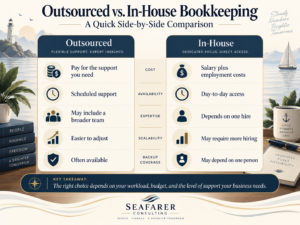
| Factor | Outsourced | In-House |
| Cost structure | Monthly, hourly, or project fee | Salary plus employment costs |
| Daily availability | Based on service agreement | Usually higher |
| Scalability | Easier to adjust | May require additional hiring |
| Internal knowledge | Develops over time | Often stronger |
| Broader expertise | Often available through a team | Depends on employee |
| Training | Provider responsibility | Employer responsibility |
| Backup coverage | Often available | May depend on one person |
1. Compare the Full Cost
Cost is often one of the biggest factors in an outsourced vs in-house bookkeeping decision.
Don’t just compare a monthly fee to a basic hourly payment. When you have a full-time employee, they come with extra costs like payroll taxes, health insurance, paid time off, software access, equipment, and training time.
According to the U.S. Bureau of Labor Statistics, the median annual wage for bookkeeping, accounting, and auditing clerks was $50,670 in May 2025.
Employers also pay their share of payroll taxes. According to IRS Publication 15, employers generally pay 6.2% for Social Security, up to the annual Social Security wage base, and 1.45% for Medicare. Together, that is 7.65% on wages subject to both taxes.
On a $50,670 salary, that adds approximately $3,876 per year in employer Social Security and Medicare taxes. That puts salary plus employer FICA at approximately $54,546 per year, or $4,546 per month, before adding unemployment taxes, benefits, paid time off, recruiting, training, software, equipment, and other employment costs.
In practice, standard outsourced bookkeeping for a small business often falls between $300 and $1,500 per month, depending on transaction volume, complexity, and the scope of work. More complex businesses with multiple entities, inventory, payroll, or higher transaction volume may pay $2,500 or more per month.
That does not make outsourcing automatically cheaper in every situation because the scope is different. An outsourced provider is generally not giving you one employee for 40 hours every week. The real comparison is the level of support your business actually needs.
However, if your business genuinely needs someone working on financial tasks throughout the day, hiring internally may still make more sense.
The main question: How many hours do you need your bookkeeper to work each week?
2. Consider Availability
An in-house bookkeeper is easier to talk to and simple to access throughout the day. If your business has constant questions about invoices, vendors, payments, customers, or internal departments, they are usually easier to reach throughout the day.
Outsourced bookkeeping is different. Communication happens through clear channels, with set deadlines and clear response expectations, but they won’t be available every minute of the day. For many small businesses, this level of scheduled support is more than enough. But for companies with high daily financial activity, an internal employee is often the better fit.
3. Think About Expertise
An in-house bookkeeper only brings the experience of one person. An outsourced accounting firm, on the other hand, gives you access to the collective experience of a whole team, ranging from routine bookkeepers to accountants, controllers, and fractional CFOs.
This becomes very valuable as your business grows beyond basic bookkeeping. Over time, you may need help with month-end closes, cash-flow forecasting, budgeting, financial reporting, internal controls, and strategic planning. Before choosing an employee or a provider, think about the level of expertise your business will need over the next few years, not just today.
4. Plan for Scalability
Bookkeeping needs can change quickly. As your company grows, you might add more transactions, hire new staff, open another location, create a second legal entity, add inventory, use new payment platforms, or need more detailed reporting.
With an internal setup, an increased workload usually means embarking on another long hiring process for additional staff. An outsourced provider, however, can often offer more support without requiring you to hire anyone new. As your business expands, scalability should be a key part of your decision.
5. Don’t Forget Backup Coverage
What happens if the single employee handling your books goes on vacation, takes medical leave, or leaves the company entirely? If your business depends completely on one person, your financial operations may face disruptions. The same risk can exist with a solo freelance bookkeeper.
An outsourced bookkeeping firm may reduce that risk by providing backup team members who can step in to maintain continuity. However, not every firm provides strong backup coverage. When interviewing a provider, always ask: Who handles our books if our assigned bookkeeper is unavailable?
6. Focus on Security and Financial Controls
Access to your financial systems should be carefully controlled regardless of whether your books are managed by an internal employee or an outsourced firm. Essential safeguards include:
- Separate user accounts for every individual
- Limited access permissions inside software
- Clear payment approval processes
- Regular reviews of account reconciliations
- Strict separation between entering transactions and approving payments
Neither model is automatically safer than the other. What really matters is having strong financial controls in place and ensuring the person or team handling your records is trustworthy and reliable.
When Does Outsourced Bookkeeping Make Sense?
Outsourcing can be a great fit when:
- Your workload doesn’t require a full-time bookkeeper.
- Bookkeeping is taking up too much of the business owner’s time.
- Your books are messy or falling behind.
- You need strong, reliable monthly financial reports.
- Your workload changes throughout the year.
- You want access to higher-level accounting or controller support as your business grows.
When Does an In-House Bookkeeper Make Sense?
An in-house bookkeeper may be a better fit when:
- Your financial tasks need dedicated attention for the entire day.
- Your transaction volume is consistently high.
- You need constant internal communication regarding your financial requirements.
- Your business uses specialized, advanced processes.
- There is enough ongoing work to justify hiring a dedicated full-time employee.
A Third Option: The Hybrid Model
It’s not necessary for you to choose just one of them. Many businesses mix internal and outsourced support to get the best of both worlds.
For example, you could have:
- An in-house bookkeeper combined with an outsourced controller
- An in-house AP/AR team combined with an outsourced month-end close
- Internal accounting staff combined with a fractional CFO
This combination gives you the convenience of an internal employee for daily tasks, while getting additional expertise from an outsourced specialist when you need it.
An outsourced vs in-house bookkeeping decision does not always have to be all-or-nothing.
Questions to Ask Before Making a Decision
Before choosing one of the three models, ask yourself these key questions:
- How many bookkeeping hours do you actually need each week?
- Do you really need someone to be physically available every single day?
- How complex are your books?
- How much would it actually cost you to hire an internal employee (including full overhead)?
- Does your business only need basic bookkeeping, or do you need higher-level financial support?
- How would it affect your business if your primary bookkeeper is unavailable?
- Is the setup you choose today still going to work as your business grows?
Frequently Asked Questions
Is outsourced bookkeeping cheaper than hiring in-house?
It can be, especially when a company does not need a full-time employee. The right comparison is the total cost of an internal employee versus the complete cost and scope of outsourced support.
When should a small business outsource bookkeeping?
It may be time when bookkeeping is consuming too much owner time, records are falling behind, or the business needs better reporting without adding another full-time employee.
Can I use both outsourced and in-house bookkeeping?
Yes. A hybrid model can combine internal staff with outsourced accounting, controller, or fractional CFO support.
What is the difference between an outsourced bookkeeping firm and a freelance bookkeeper?
A freelance bookkeeper is one independent professional, while an outsourced bookkeeping firm may have a larger team supporting the account. A firm may offer more backup coverage and access to different levels of accounting expertise, but the actual services depend on the provider.
How much does an in-house bookkeeper cost?
The U.S. Bureau of Labor Statistics reported a median annual wage of $50,670 for bookkeeping, accounting, and auditing clerks in May 2025. Employers also have payroll taxes and may have additional costs for benefits, paid time off, software, equipment, recruiting, and training.
Which Option Is Right for Your Business?
There is no single answer. The right outsourced vs in-house bookkeeping choice depends on how much support, availability, and expertise your business needs.
A smaller company may benefit from outsourcing because it needs professional support without a full-time employee. A larger business with constant financial activity may benefit from having someone in-house.
The better question is:
What level of financial support does your business need today, and what will it need as it grows?
Talk to Seafarer Consulting
If you’re deciding between outsourced and in-house bookkeeping, Seafarer Consulting can review your current workload, systems, reporting needs, and growth plans to help determine the right level of support.
Book a free consultation with Seafarer Consulting to review your current bookkeeping setup and determine what level of support makes sense for your business.